

Can You Sell a Car Without a Title in Virginia?
Most people trying to sell a car without a title in Virginia are not dealing with a normal car sale. Usually the title disappeared years ago, the vehicle kept sitting, and one day the situation suddenly became urgent.
Maybe the owner moved out of state, the title was lost during a move, the vehicle belonged to a family member nobody can contact anymore, or someone bought the car years ago and never properly registered it.
At first, people think: “I'll deal with it later.”
Then later turns into a dead battery, flat tires, HOA pressure, abandoned-vehicle notices, insurance bills, property tax confusion, family stress, and a vehicle nobody wants to keep looking at anymore.
Eventually, people start looking for real answers — whether a junk car can be sold without a title, what paperwork is needed, and whether a licensed buyer can legally remove the vehicle.
The biggest misconception we see in Virginia is this: “No title means I'm stuck with the car forever.”
That is not true for many older vehicles. Licensed Vehicle Removal Operators and auto recyclers can legally purchase certain vehicles without titles when proper documentation is collected. That is why understanding how the process actually works matters before assuming the situation is hopeless.
Why Older Junk Cars Without Titles Are Treated Differently in Virginia
Virginia law handles certain older no-title vehicles differently than newer ones. Under Virginia Code § 46.2-1608.2(D), licensed auto recyclers may legally demolish a vehicle without a title when the vehicle's model year is at least 10 years older than the current model year. Before proceeding, the auto recycler must provide the VIN, year, make, and model to the Virginia DMV electronically — and the DMV checks both a nationally recognized crime database and a nationally recognized vehicle title database before the auto recycler is cleared to proceed. That check protects sellers by confirming the vehicle is not stolen and verifying ownership and lienholder information.
Vehicles newer than 10 model years require a title for any legal transfer. If the title is missing on a newer vehicle, the process is straightforward and worth completing before calling any buyer.
Even for qualifying older vehicles, the exact situation still matters. Vehicle age, ownership circumstances, VIN verification, available paperwork, and DMV database results all factor into whether the vehicle qualifies. That is why experienced licensed recyclers review every situation individually rather than giving one generic answer to everyone.
How to Get a Replacement Title in Virginia
To get a replacement car title in Virginia, the registered owner must complete the Application for Replacement and Substitute Titles — Virginia DMV form VSA 67 — and pay a $15 fee. The application can be submitted online at dmv.virginia.gov or in person at any Virginia DMV customer service center.
For most sellers, that process takes a short amount of time and pays for itself many times over. A titled vehicle opens the door to more buyers, a wider pool of offers, and a smoother transaction from start to finish.
If getting to the DMV is not possible — or if the situation involves an estate, a family member who has passed, or any circumstances where the registered owner cannot personally complete the application — Dalo can handle the title replacement process on the seller's behalf with a Power of Attorney.
To authorize Dalo to act on the seller's behalf, the seller provides a notarized Power of Attorney. The preferred Virginia DMV form for this is the Virginia Power of Attorney to Sign for Owner — form VSA 70. If using a vehicle-specific POA, the VSA 70 is the form Virginia DMV recommends. Once the notarized POA is provided, Dalo handles the replacement title process directly so the seller does not have to navigate the DMV paperwork alone.
That combination — VSA 67 for the replacement title and VSA 70 for the POA — covers most situations where a newer no-title vehicle needs to be legally transferred and the seller cannot complete the process independently.
Why Do Cars Without Titles Sit for Years?
Most no-title vehicles do not suddenly become problems overnight. They sit because people assume they have no options.
The vehicle may be parked behind the house, sitting in the yard so long people stopped noticing it, or connected to a family member who moved away years ago. Sometimes it was supposed to become a project someday and just never did.
At first the vehicle is not bothering anybody. Then something changes — the HOA complains, the property gets sold, the mechanic wants the space back, the county sends notices, or the family finally wants the driveway clear.
That is when people start searching for real answers. We hear it almost every week: “This thing has been sitting there forever, and now it needs to move today.”
It happens constantly across Northern Virginia — in Stafford, Woodbridge, Fairfax, Alexandria, and Springfield, where older vehicles sit beside homes, garages, storage lots, and townhouses for years before the situation suddenly becomes urgent.
Most No-Title Situations Are Family Situations
A large percentage of no-title vehicle situations are tied to family circumstances. Inherited vehicles, abandoned family cars, project vehicles left behind by relatives, and older cars sitting unused on family property for years are the most common scenarios we deal with.
Sometimes the vehicle is technically still in a brother's name, a parent's name, or somebody who moved away years ago and never transferred the paperwork. The vehicle stays parked because nobody wants to deal with the ownership confusion. Eventually, someone asks:
“Can I legally sell this if it belonged to a family member?”
Most no-title situations are not suspicious at all. They are old life situations and unfinished paperwork problems that quietly accumulated over time. That is exactly where local operational experience matters — because the paperwork, vehicle condition, pickup logistics, and ownership situation all have to line up correctly.
Inherited Car Without Title
An inherited vehicle without title paperwork is stressful because the car is usually connected to years of family history. Sometimes it belonged to a parent, a grandparent, or a family member who passed away. Sometimes it was somebody's first car or an unfinished project they planned to restore.
People say things like: “This was my dad's car.” Or: “I cannot believe this thing has been sitting here this long.”
Eventually somebody in the family still has to figure out what to do with it. If the title is missing, most people assume the car can never be sold. For many older vehicles in Virginia that is not true — a licensed recycler may still be able to help when proper documentation is collected.
Most people are not just trying to sell a no-title vehicle. They are trying to finally resolve a situation that has quietly been sitting unresolved for years.
If the vehicle came to you through an estate, the bigger question is often whether you have the authority to sell it yet — which is a separate issue from the title itself. Our guide on how to sell an inherited vehicle in Virginia walks through the executor, small-estate, and contested paths.
Abandoned Car Without Title
An abandoned vehicle without title paperwork can quietly become a serious property problem. This happens when somebody buys a property with an old vehicle already there, a tenant leaves a car behind, a family member disappears, a project gets abandoned, or a vehicle simply sits untouched in a yard for years.
Eventually the HOA starts sending letters, the county notices the vehicle, the property needs to be sold, or the mechanic shop wants the space back.
In these situations, the main question is usually not “How much is this car worth?” The real question is “How do I legally get this thing out of here?” That is where experienced local junk car removal companies with no-title paperwork knowledge become essential.
Some Project Cars Never Become Projects Again
A significant number of no-title situations involve unfinished project cars that slowly got abandoned. Somebody starts a build, pulls the engine, removes the transmission, starts collecting parts — then life changes before the project is ever finished.
Years later, the title is gone, parts are missing, the previous owner cannot be contacted, and the project is no longer realistic. Sometimes the engine is sitting beside the car, the vehicle is on cinder blocks, and parts are scattered through the garage.
Many people eventually admit: “I'm never going to finish this thing.”
Project cars can be emotionally difficult to let go of, but many become storage problems, paperwork problems, and space problems all at the same time.
What Paperwork Do You Need to Sell a Junk Car Without a Title?
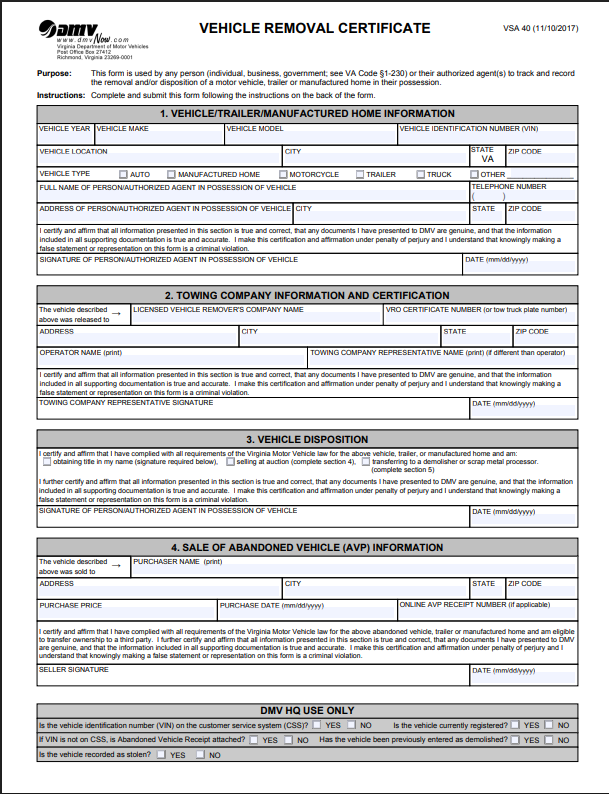
The paperwork required depends on the vehicle's age and the ownership situation. For older vehicles being processed by a licensed Virginia VRO or auto recycler, the required documentation includes:
- Vehicle Removal Certificate (VSA 40) — the Virginia DMV form that documents the legal transfer
- Valid seller identification — government-issued photo ID
- Photo verification — a photo of the seller next to the vehicle at pickup
- Bill of sale — always required to document the transaction
Missing paperwork does not automatically mean the vehicle cannot be removed legally. The documentation process exists to protect everyone involved and satisfy Virginia DMV requirements. In many situations, licensed recyclers help guide sellers through what is needed rather than leaving them to figure it out alone.
What Happens If the Car Is in Someone Else's Name?
This is one of the most common situations we deal with. The vehicle may technically belong to a brother, sister, parent, previous owner, or somebody who moved away years ago and never transferred the paperwork.
That depends on the ownership situation, the age of the vehicle, and what documentation is still available. Situations like this happen constantly with older family vehicles where somebody moved away, passed away, or simply lost the title years earlier and never corrected it. The vehicle quietly sits for years without the situation ever being fully resolved.
Years later, whoever is handling the property becomes responsible for a no-title vehicle they never wanted to deal with. Clear communication, realistic expectations, and local operational experience are what make these situations solvable.
Cars That Sit Too Long Become Bigger Problems
A vehicle that sat untouched for years is a different problem than one that stopped running last month. Expired tags, flat tires, mold, rust, dead batteries, rodent damage, missing paperwork, and HOA pressure all accumulate quietly until the situation becomes urgent.
That is especially common in Northern Virginia — in Stafford, Woodbridge, Fairfax, Alexandria, and Springfield — where older vehicles sit beside townhomes, garages, storage lots, and inherited property for years.
For older vehicles that no longer run, the paperwork problem usually combines with a removal problem at the same time. Once the tires go flat, the vehicle no longer moves, or the property situation becomes urgent, the situation becomes significantly more complicated to resolve. The earlier it gets addressed, the cleaner the process.

How No-Title Junk Car Removal Actually Works
The process starts with honest information about the actual situation — not assumptions about what is or is not possible.
Buyers need to know whether the vehicle still rolls, whether major parts are missing, whether the catalytic converters are present, whether the vehicle is accessible for pickup, what paperwork exists, who the vehicle belonged to, and how long it has been sitting.
Once the real situation is understood, the next steps become clear: what paperwork is needed, whether the vehicle qualifies, how pickup would work, and whether the vehicle still has value or simply needs removal.
That is why experienced local junk car removal companies handle these situations differently than national call centers. A national operator may not know Virginia's specific title requirements. Local licensed recyclers deal with these situations every week.
Will I Still Get Paid for a Junk Car Without a Title?
For many older vehicles that qualify under Virginia requirements, yes. The condition of the vehicle still matters — a complete vehicle with engine, transmission, catalytic converters, and major components intact is worth more than a stripped shell with parts removed.
A quote for a complete vehicle is not the same as a quote for a vehicle missing its engine and catalytic converters. That does not prevent legal removal — it simply affects the offer. Accurate information upfront means fewer adjustments at pickup and a smoother transaction.
Local Buyers vs National Lead Systems
Most people dealing with no-title situations are already stressed before they make the first call. National lead systems add to that stress — the lead gets sold, another company gets assigned, a third-party towing provider gets dispatched, and suddenly there is no clear local point of contact, no consistent communication, and pricing that changes between the quote and the pickup.
Most people want clear answers, realistic expectations, and somebody who shows up when they say they will. That matters more in complicated no-title situations than in any other type of junk car transaction — because the paperwork, the vehicle condition, the ownership situation, and the pickup logistics all have to align correctly.
Local operational experience is not a marketing claim in these situations. It is the actual difference between a situation that gets resolved and one that drags on for months.
Why the License of Your Buyer Matters More Than Most Sellers Realize
Not every buyer who offers to take a no-title vehicle in Virginia can legally do so.
In Virginia, only two categories of licensed operators can legally purchase a vehicle without a title: a licensed Vehicle Removal Operator (VRO) and a licensed auto recycler. A used car dealer cannot legally buy a no-title vehicle. A private buyer off Craigslist or Facebook Marketplace cannot legally buy a no-title vehicle. A tow truck operator without the proper license cannot legally buy a no-title vehicle. The license is not a technicality — it is the legal authority to take ownership of a vehicle that has no title documentation.
That distinction matters enormously for the seller because of what happens after the vehicle leaves the property.
When a licensed demolisher acquires a vehicle, they are required to report it through the Vehicle Disposition Reporting system — VDR — at the state level through Virginia DMV, and through NMVTIS — the National Motor Vehicle Title Information System — at the federal level. Those reports are what remove the vehicle from the seller's name in both state and federal records. Once those filings are made, the vehicle is no longer the seller's legal or financial responsibility.
The seller still has their own obligations to complete — notifying Virginia DMV of the sale and returning the license plates. Those steps are the seller's responsibility regardless of who buys the vehicle. But once the licensed demolisher files the VDR and NMVTIS reports, the vehicle itself is off the seller's name in both systems.
When an unlicensed buyer takes the car, neither report gets filed. The vehicle stays in the seller's name in both the Virginia DMV system and the federal NMVTIS database. Property tax notices keep arriving. Registration renewal notices keep arriving. If the vehicle gets abandoned somewhere, towed by a municipality, or involved in any kind of incident — it is still legally connected to the seller's name. Months or years later, the seller is trying to track down a bill of sale from someone they found on Facebook who has no paper trail and no legal obligation to anyone.
That is the real risk of handing a no-title vehicle to an unlicensed buyer who simply says they can handle it.
Dalo Auto Recycling holds a VRO license, a demolisher license, a salvage dealer license, and a dealer license — all issued through Virginia DMV. That combination means every step of the no-title transaction is legally authorized, properly documented, and reported to both state and federal systems. The vehicle comes off your name the right way.
Most People Just Want the Situation Resolved
At a certain point, most people are no longer focused on the money. They want the problem solved.
“I'm just happy this thing is finally gone.”
“At least I don't have to pay insurance on it anymore.”
“I don't have to hear from the HOA anymore.”
That relief is the real outcome behind most no-title vehicle situations. The vehicle stops being a source of stress, paperwork anxiety, family tension, and property clutter that has been sitting unresolved for years.
A no-title junk car is rarely just an old car. It is usually a situation that quietly accumulated over time — and the people dealing with it are not looking for a transaction. They are looking for a resolution.