
First, the one question that decides everything: do you still own the car? If your insurance company already paid your claim and took the vehicle, you can't sell it — it isn't yours anymore; it goes to a salvage auction like IAA or Copart. This guide is for owners who still have the car because insurance isn't taking it.
If your car was wrecked in an accident and you're trying to sell it yourself, one thing is already true: your insurance company isn't taking it. When an insurer declares a car a total loss, they normally keep it and send it to a salvage auction like IAA or Copart — you never have to find a buyer. So if you're reading this, the car is yours to deal with, and the clock is probably running, because a wrecked car usually isn't sitting in your driveway. It's at a tow yard, and the bill is growing every day.
This guide walks through exactly what to do: why a totaled car still has real value, how tow-yard storage fees pile up and how fast, when it makes sense to sell quickly, and the one situation where the smartest move is not to sell at all — but to sign the title over to the tow yard and walk away. We'll use a real car Dalo bought as the example.
Can you even sell a car that's been totaled?
It comes down to one question: who owns the car right now?
If your insurance company declared it a total loss and paid you out, the insurer almost always keeps the car and sends it to a salvage auction. In that case you can't sell it — it isn't yours anymore. But there's a large group of people for whom insurance isn't paying at all: the car was older and only had liability coverage, the accident wasn't covered, or you chose to keep the car after a payout. If insurance isn't taking your wrecked car, then it's yours to sell — and a licensed recycler can buy it directly.
That's the dividing line for this whole page. If you're trying to find a buyer for your wrecked car, it's because the insurance route isn't an option — so the question becomes how to get the most for it before it costs you money to keep.
What if I kept the car after the insurance payout?
Some owners keep the vehicle after an insurance payout — called owner-retained or retained salvage. When you do, the car is usually issued a salvage title. That's normal, and it doesn't stop you from selling it: Dalo buys salvage-title cars the same as any other totaled vehicle, because the value is still in the parts, converter, and scrap.
The salvage title is mostly a paperwork matter. If you're unsure about the title side of things — replacing a missing one, or how the paperwork works for an older vehicle — that's covered in detail in can you sell a car without a title in Virginia.
"Totaled" doesn't mean worthless
A car is "totaled" when the cost to repair it is more than the car is worth to fix — not when the car has no value left. Those are very different things. A vehicle that's totaled from a side hit or a rear-end collision often has a perfectly good engine, transmission, and catalytic converter, plus undamaged wheels, glass, and body panels. To a licensed recycler, that's exactly where the money is.
This is why a recycler can pay real money for a car the insurance company walked away from, and usually more than a scrap-only buyer: the recycler recovers the value of the usable parts and the converter, not just the metal weight. If you want the full picture of where that value comes from, see what makes a junk car valuable and how junk car buyers calculate value.
Why your car is at a tow yard — and why the bill grows daily
Here's the part almost nobody explains. After an accident where the car can't be driven and it's blocking the road, the police call whichever towing company is on that county's rotation to clear the scene. Your car goes to that company's storage lot — and the meter starts running immediately. Every day it sits, the bill grows.
The exact charges vary by county and by which company is on the rotation, but the pattern is the same everywhere. To put real numbers on it, here's a recent example from a Spotsylvania County rotation tow:
Accident tow (police rotation)
One-time charge to tow the car from the scene to the yard's lot.
~$350
Daily storage
Charged every day the car sits on the lot.
~$75 / day
Administrative fee
Added by many yards within the first few days.
~$250
Fuel surcharge & cleanup
Some counties now add a fuel surcharge; spill or debris cleanup costs extra.
+ varies
In just three days, that car can already owe around $800 — roughly $350 to tow, about $225 in storage ($75 a day), and a ~$250 administrative fee, all before you've sold anything, with a fuel surcharge and any cleanup on top of that. And that's only three days. Your county's exact figures will differ, but the lesson holds everywhere: the longer the car sits, the more of its value disappears into storage. On an older or heavily damaged car, the bill can pass what the car is worth in a week or two. We see this all the time with wrecked cars stuck at tow yards in Stafford along the I-95 corridor — by the time the owner calls, the storage tab has already taken a real bite out of the car's value.
Two situations — and what to do in each
Once you understand the clock, the decision is really just figuring out which of two situations you're in.
1. The car is worth more than the bill → sell it fast
If your totaled car still has a good engine, converter, and parts, it's likely worth more than the storage bill has reached — especially in the first few days. This is the time to act. Get a real offer right away, compare it to what you owe the yard, and if the car is worth more, sell it before storage eats into the difference. Every day it sits is money lost to the yard — money that could go toward your next car instead. A licensed recycler handles the free towing and removal and pays you on pickup, so the offer goes straight to you.
2. The car is worth less than the bill → sign the title to the tow yard
Sometimes the storage bill has already grown bigger than the car is worth — or the car was old and low-value to begin with. In that case, the honest answer is usually not to sell it to anyone. The better move is to ask the tow yard if you can simply sign the title over to them and walk away from the bill.
It's genuinely a win-win. You've just lost a car and you're probably already facing the cost of replacing it — the last thing you need on top of that is to pay a storage bill that's bigger than the wreck and then coordinate a sale and a pickup. Signing the title over to the yard lets you clear it off your plate and put your energy toward your next car. And it helps the tow yard too: if you simply abandon the car, the yard has to wait out the storage-lien process — at least 60 days, often 90 or more — before it can get a title and clear the car off its lot. A title swap gets the car off their hands now, which is why many yards will agree to it. A buyer worth trusting will tell you when this is your better option instead of trying to buy a car that isn't worth buying.
A real example: a totaled 2017 Kia Soul
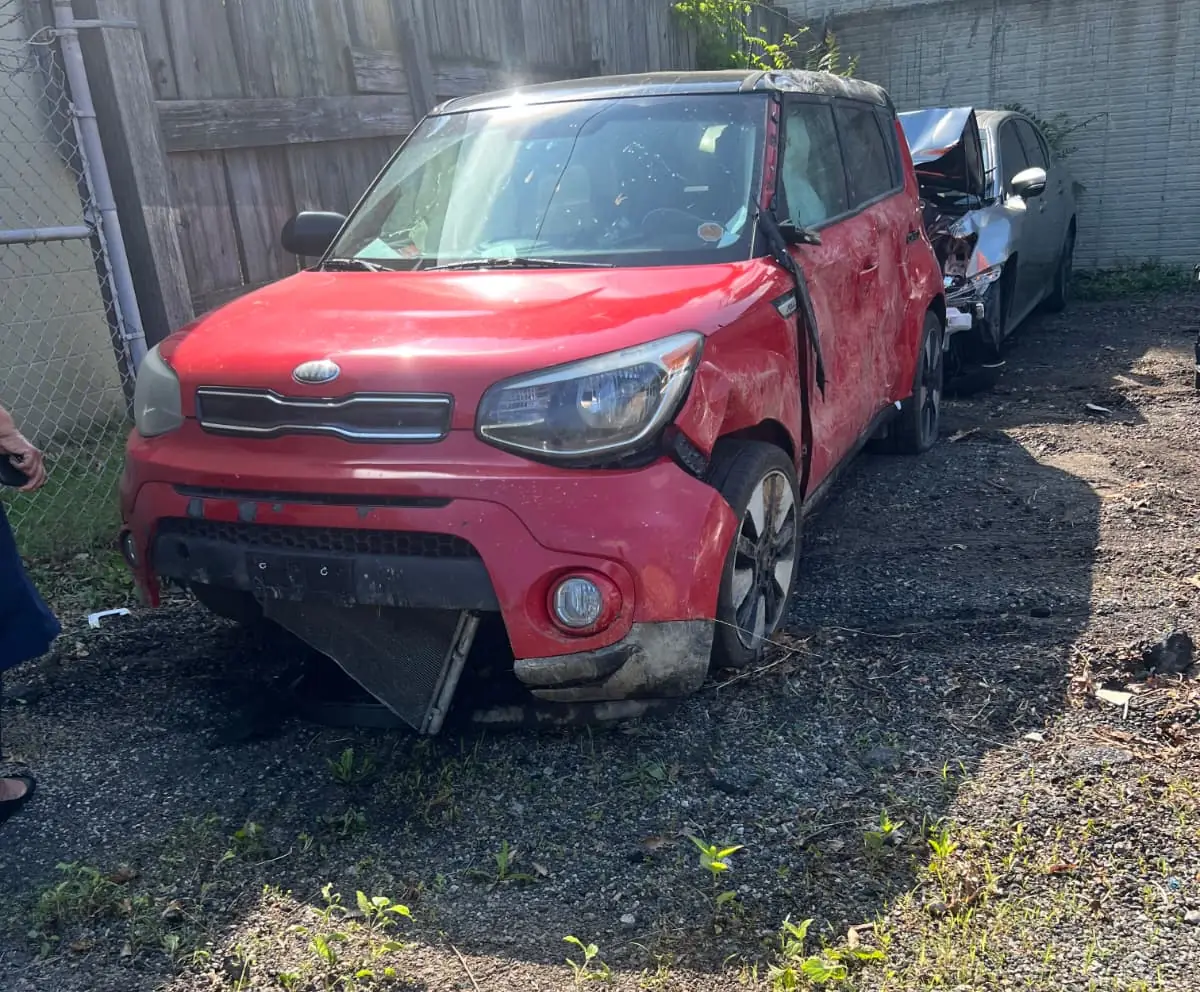
A red 2017 Kia Soul was wrecked in an accident over a weekend and towed to a tow yard in Woodbridge. The car was totaled — heavy front and side damage, the front end caved in, airbags deployed — but the 2.0-liter engine and drivetrain came through it intact, and that's where the value was.
The owner did the one thing that matters most: she didn't let it sit. She called Sunday morning, the day after the accident, and Dalo picked the car up Monday afternoon — paying her $1,100 with free towing. Because she moved fast, storage fees hadn't had time to eat into the car's value, and a vehicle the insurance company wasn't paying on still put real money in her pocket. Had it sat at the yard for a week or two instead, that $1,100 would have been steadily chipped away by the daily storage bill.
(The $1,100 was the offer for the car itself. Parts and scrap values move over time, so this reflects that specific car at that time, not a fixed price for any Kia Soul.)
How pickup works when the car is at a tow yard
One thing to know up front: the storage bill and the release are between you and the tow yard. That part is yours to settle — a buyer pays for the car, not your storage tab. Once that's handled, how the physical pickup goes depends on the yard:
Some yards let our truck come inside, inspect the car, and do the paperwork right there. Others won't allow outside trucks onto the lot — in that case, you clear the release with the yard, they move the car outside the gate, and we pick it up from there and pay you. The same goes for pickups from body shops and collision lots in Fairfax County, where a wrecked car often sits at the shop after an insurance estimate came back too high to repair. Either way, once the car is released, Dalo handles the towing and the purchase paperwork. If you don't have the title, that's a separate matter from the storage release; for older vehicles it can often still be sold, as explained in can you sell a car without a title in Virginia.
The fastest way to know where you stand
Because the tow-yard clock is running, the most useful thing you can do is find out quickly whether your car is worth more than the bill. A real instant offer gives you a number in about a minute, so you can compare it to what you owe the yard and decide: sell it now, or sign the title over. You don't need a VIN — just the year, make, model, mileage, and the car's condition. If the wreck is more about a dead drivetrain than collision damage — or the car simply won't start anymore — the guide to who buys cars that don't run covers that side, and sell a non-running car walks through how we handle vehicles that no longer start. Totaled cars that still run are covered under sell your totaled car, and for an Arlington-area pickup specifically see sell a totaled car in Arlington.
Find out what your wrecked car is worth — before the bill grows
Get a real instant offer in about a minute, then decide: sell it fast, or walk away. Free towing across Northern Virginia, paid on pickup. We'll tell you honestly if it's not worth selling.